
On Sunday, July 9, my ecology class visited Willisbrook Preserve, an area protected by the conservation organization Natural Lands. It is located in the Piedmont Uplands, not far from Malvern, Pennsylvania. Willisbrook Preserve includes woods, grasslands, and a rare ecosystem known as serpentine barrens. Serpentine soil is rich in magnesium and iron, which is a challenging medium for many plant species, but which allows some rare species to adapt and flourish in southeastern Pennsylvania. The area underlain by serpentine is bordered by Serpentine Run; we also crossed the run to explore a forest underlain by gneiss in order to contrast the two geologic regions.
It was a warm day, about 75°F, and humid and hazy when we left Philadelphia; even at that early hour, the skyline seemed to disappear into a low cloud. At the trailhead, it was still misty but much cooler than in the city; by midmorning, however, we fled the trail to stay ahead of thunderstorms and heavy downpour.
Serpentine Virginia Pine-oak forest trail
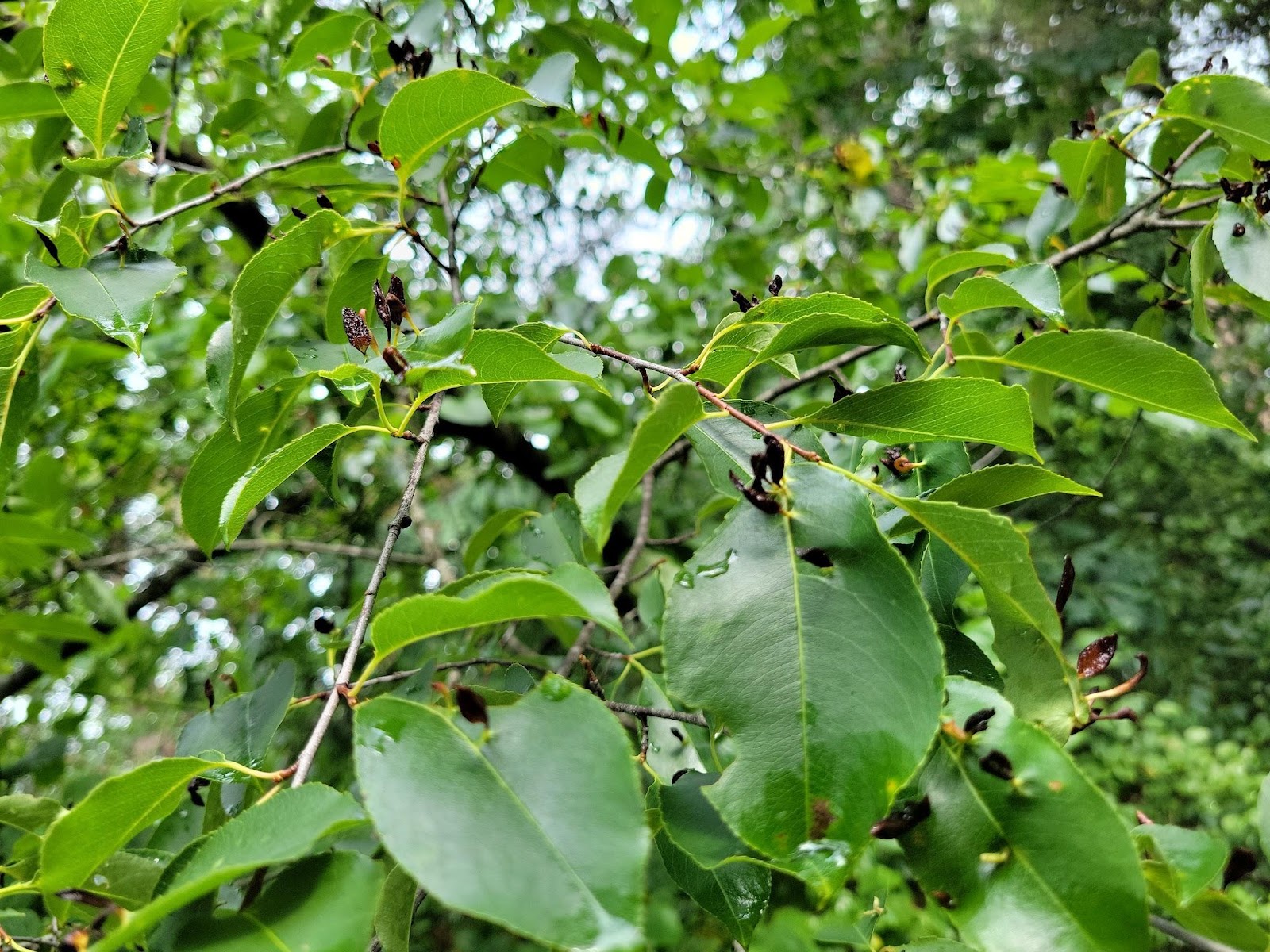
Serpentine bedrock underlies the wooded trail off Sugartown Road and adjacent fields, but is deep enough below the surface that the soil supports mature trees. The trail is shaded by a canopy of various oak species, including white oak (Quercus alba) and pin oak (Quercus palustris), as well as Virginia pine (Pinus virginiana) and shagbark hickory (Carya ovata). The understory was nearly overrun by what appeared to be roundleaf greenbrier (Smilax rotundifolia), although when we turned over their leaves and saw that some of them had pale undersides, we knew that catbrier (Smilax glauca) was also present. Brambles (Rubus spp.) and scattered deerberry (Vaccinium stamineum) and lowbush blueberry (Vaccinium pallidum) shrubs were scattered throughout. We identified black cherry (Prunus serotina) in shrub form, some with black cherry finger gall mites (Eriophyes cerasicrumena) on the leaves; these were blackened, rather than the bright orange galls we observed last month in Mount Holly.

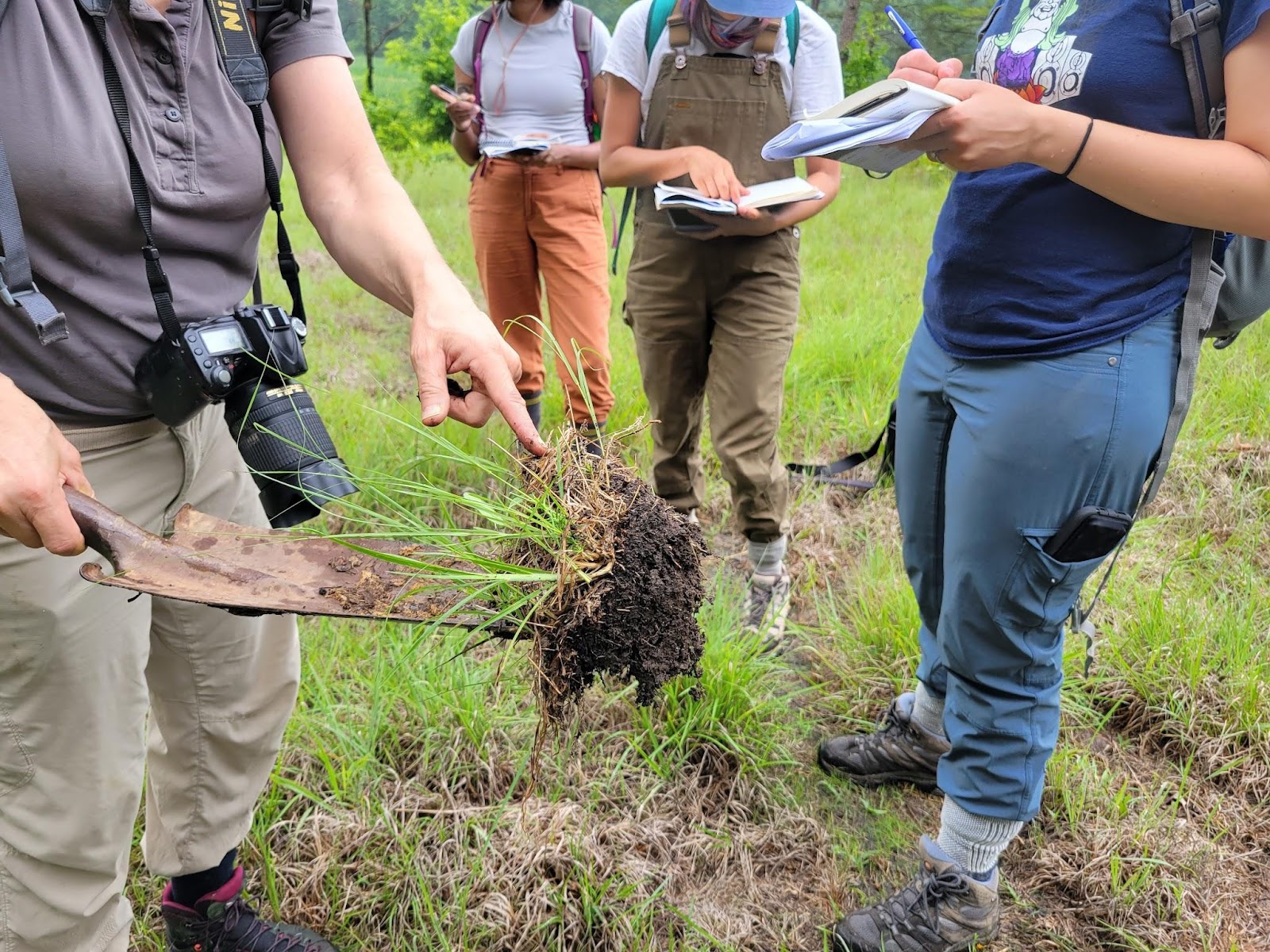
A soil sample showed moderately well-drained silt loam with an organic layer defined by leaf litter, a dark brown A horizon, and a high chroma, strong brown B horizon.

Further along the trail, we saw a tree-shaded area which had been sprayed with herbicide in 2021. The greenbrier was absent from this area, and the leaf-littered ground was visible among a scattering of grasses and many tall stalks of great or common mullein (Verbascum thapsus), just beginning to flower.

We heard repeated loud calls from an Eastern towhee (Pipilo erythrophthalmus); someone recently taught me the mnemonic “drink your TEA” to identify this call, and this towhee was emphatic that we all stay hydrated. The Merlin app also identified scarlet tanager (Piranga olivacea) and Eastern wood-pewee (Contopus virens) in this area.
Serpentine grassland and gravel forbs
Where the serpentine bedrock is closer to the surface, we found grasslands. We visited a clearing on the southern slope of the serpentine ridge that has been managed using prescribed burns for around 25 years. Most of the grasses were not in a fruiting season, which made them challenging to identify, but the area included warm-season grasses such as Indian grass (Sorghastrum nutans), little bluestem (Schizachyrium scoparium), and big bluestem (Andropogon gerardii). We saw a pasture rose (Rosa carolina) beneath the Virginia pines at the edge of the clearing. A soil sample showed minimal organic material, since grasses decompose quickly, and a 6″ A horizon. No B horizon; the shovel clanged against rock at 6 inches.
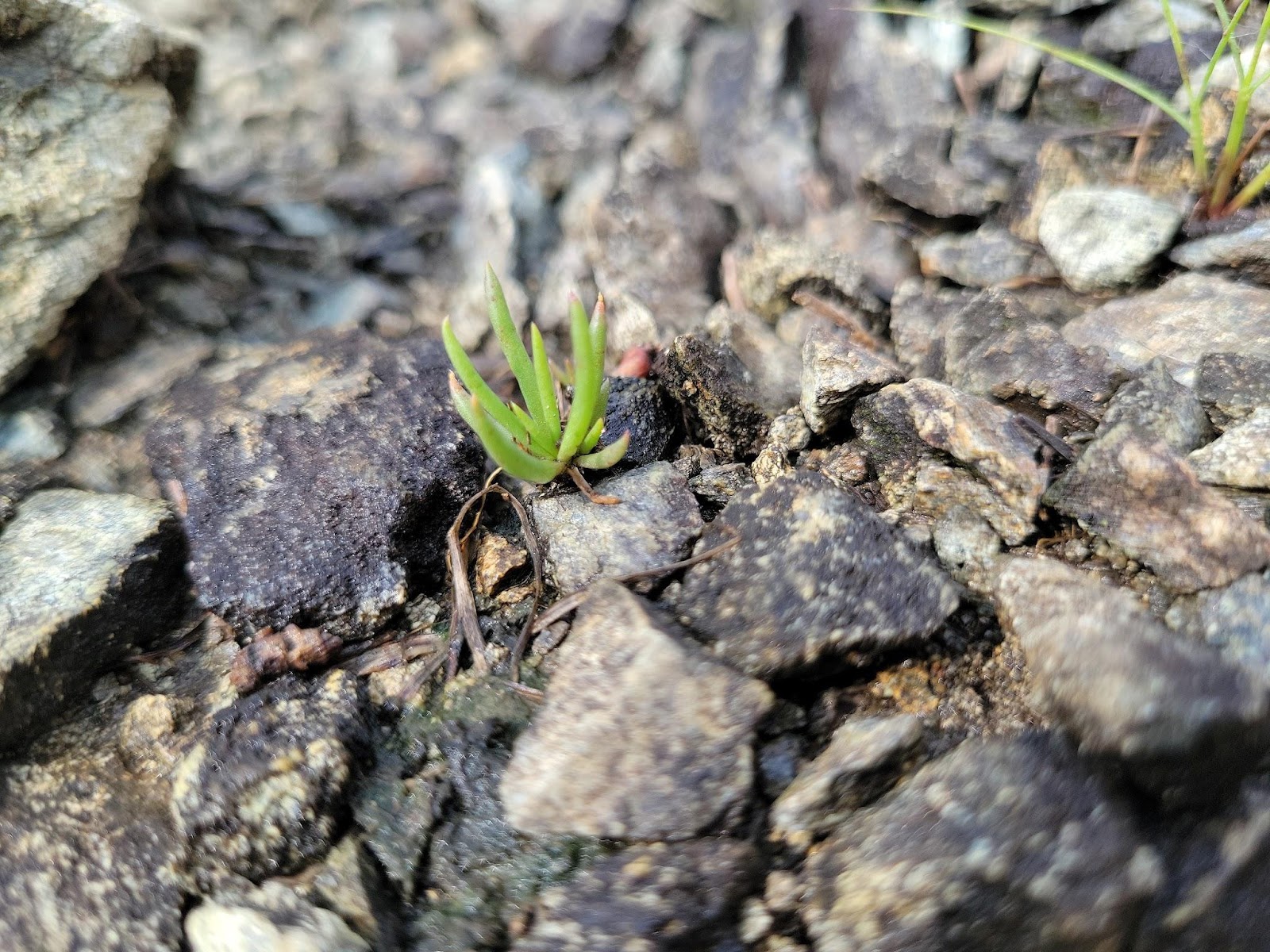
When we followed the trail out of the woods, we found exposed rock and gravel rather than dirt beneath our boots; there was very little soil, although just enough to make the gravel trail muddy after recent rains. To adapt to the nutrient-poor environment, plants in the serpentine gravel tend to have reduced, hairy, or succulent leaves. Among them is the round-leaved fameflower (Phemeranthus teretifolius), which has fleshy leaves and tiny pink flowers, which were not quite open on our morning visit. Other gravel forbs include serpentine aster (Symphyotrichum depauperatum) and lyre-leaved rockcress (Arabis lyrata).

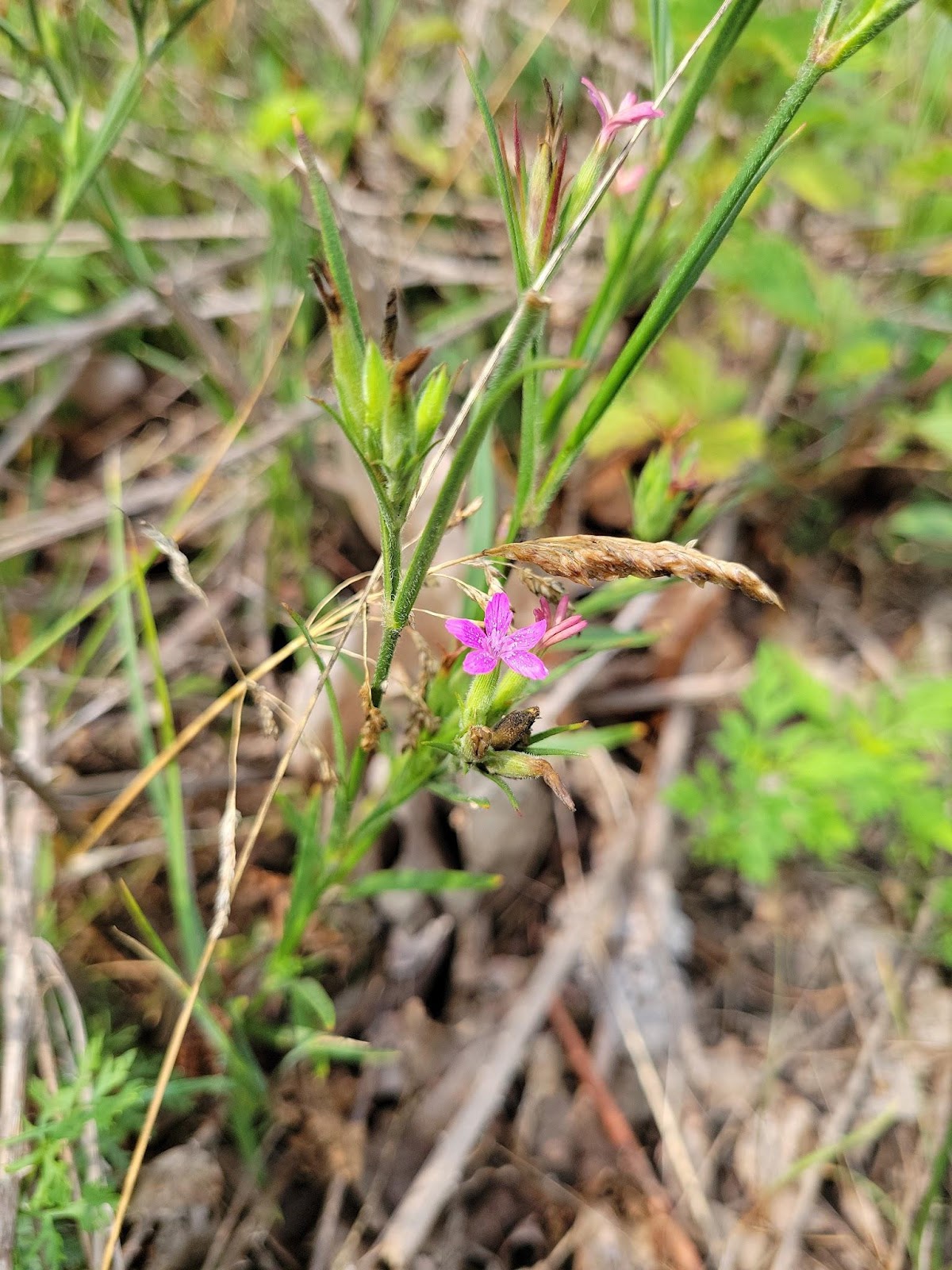
In areas off the gravel trail with slightly more soil accumulation, we saw more of the grasses and forbs that characterize the grasslands: narrowleaf mountainmint (Pycnanthemum tenuifolium) (Photo 8), Deptford pink (Dianthus armeria), sundrops (Oenothera fruticosa), and whorled milkweed (Asclepias verticillata). Some species, like moss pink (Phlox subulata), were challenging to identify because they bloom in the spring.

Serpentine Run and forest seep
Serpentine Run flows between the serpentine and the gneiss geologic regions. Willisbrook Farm uses this spring-fed creek to irrigate the cultivated fields; we also passed a cattail-dominated pond created by the farm. Further south, Serpentine Run joins other headwaters in this region to form Ridley Creek, which flows into the Delaware River near Chester.

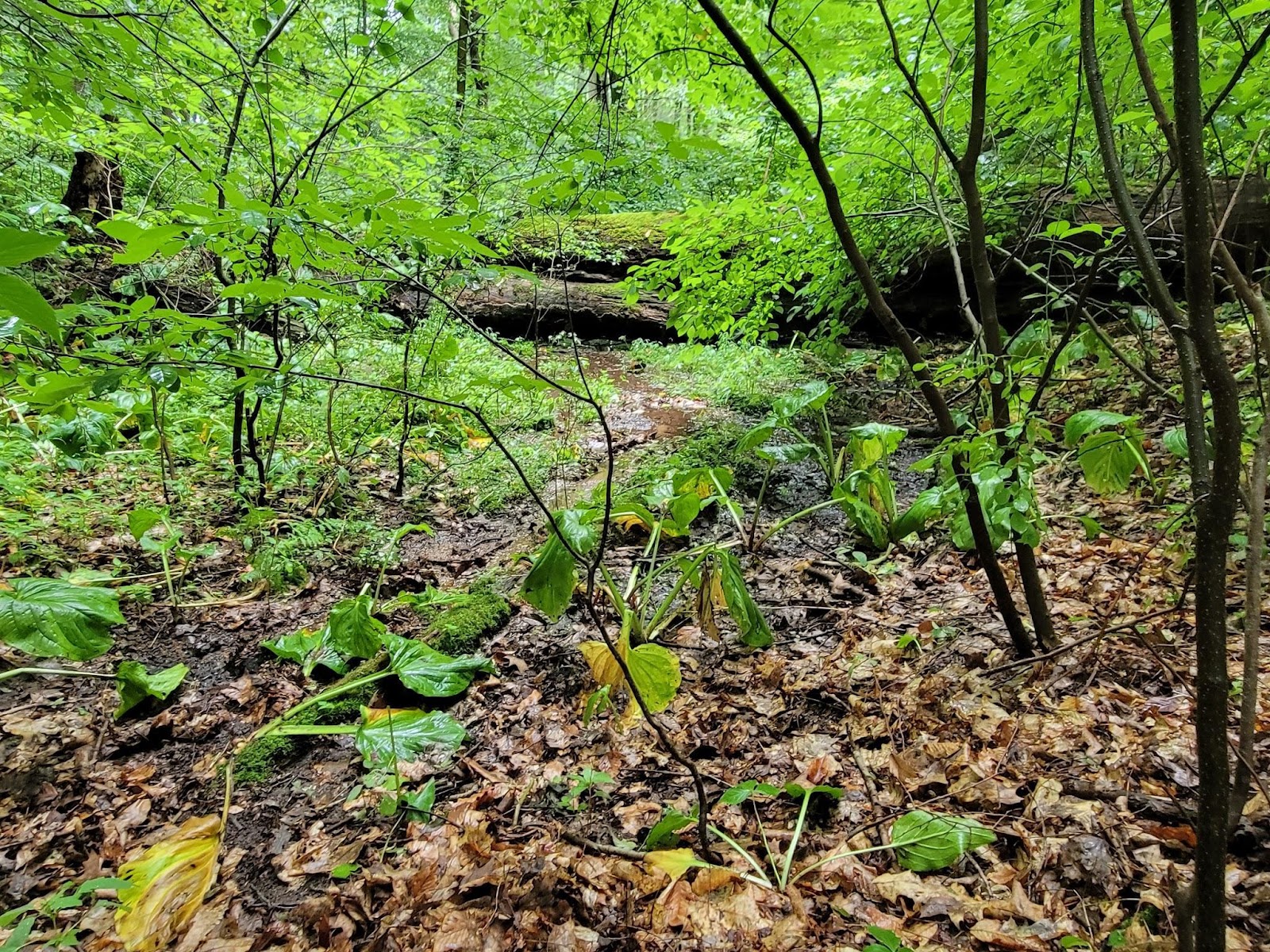
In Willisbrook Preserve, Serpentine Run forms a boundary between the regions underlain by serpentine and felsic gneiss. As a boundary goes, it is fairly well-defined: its banks are lined with trees, vines, and moisture-loving vegetation, and we crossed a low-lying bridge from one region to the next. But there was also moisture throughout the low-elevation areas of the gneiss forest, and not just from recent rains. In this area, groundwater diffuses through the slopes over an area of soil, which is moist and poorly drained year-round. A sample (not pictured) showed saturated, gray soil without clearly defined horizons. Skunk cabbage (Symplocarpus foetidus) dominates these forest seeps, although golden saxifrage (Chrysosplenium americanum) and jewelweed (Impatiens capensis) could also be seen beneath its broad leaves.
Tuliptree-Beech-Maple Forest
At a slightly higher elevation, the gneiss forest supported mature trees, predominantly tuliptree (Liriodendron tulipifera), American beech (Fagus grandifolia), and red maple (Acer rubrum); we estimated they were about 80-100″ high. We observed diverse shrubs, vines, and herbaceous plants reminiscent of the forest community in Wissahickon Valley Park: spicebush (Lindera benzoin), ferns such as interrupted fern (Osmunda claytoniana) and hay-scented fern (Dennstaedtia punctilobula), jack-in-the pulpit (Arisaema triphyllum), and hog peanut or mouse bean (Amphicarpa bracteata)—a three-leaved forageable plant that resembles poison ivy (Toxicodendron radicans) except without shiny leaves. We also saw a fair amount of Japanese barberry (Berberis thunbergii), an introduced species.
A soil sample (not pictured) showed a well-drained, bright yellow-brown B horizon beneath a dark brown A horizon. Although the ground was not as damp as in the seep, there was plenty of moisture from recent rains to encourage fungus growth. We saw many interesting mushrooms, including winter russula (Russula cremoricolor).

On these quiet wooded trails, the Merlin app recorded gray catbird (Dumetella carolinensis), common yellowthroat (Geothlypis trichas), downy woodpecker (Picoides pubescens), house wren (Troglodytes aedon), and mourning dove (Zenaida macroura).
Conclusion
The underlying bedrock can greatly influence the plant community aboveground—to a greater degree as the rock approaches the surface. The serpentine gravel community presents an extreme example; few plants are supported by the rocky surface with minimal soil, and those that do grow in this area have adapted to the lack of nutrients as well as the distinctive chemical and physical properties of serpentine. But even where there is enough soil to support mature trees, the plant communities differ greatly. On the serpentine formation, we found plants we recognized from the acidic soils of the Outer Coastal Plain, specifically pines, oaks, ericaceous shrubs, and greenbrier. On the felsic gneiss formation, we saw similarities to the Wissahickon Valley Park, which is also located in the Piedmont Uplands: beeches, mature tulip trees, and ferns. These differences, divided only by a creek, may make farming difficult, but they contribute to the biodiversity of this unusual region.
 Sara Davis