
I am taking a regional field ecology course this summer, so nearly every week my class takes a trip to a nearby park or preserve. I’ve enjoyed this so much and learned so much from these excursions that I’ve decided to post my field reports (lightly edited), for my records as well as for anyone else who loves learning about plant communities and how they interact.
Please note that I am not a scientist, just a writer and an enthusiast.
On Sunday, June 4, the class visited Island Beach State Park and Cattus Island County Park in New Jersey. The predicted weather was partly sunny and breezy (10-15 mph) with a high of 63°F. We found the weather conditions ideal for beach exploration: bright and clear, warm in the sun but not uncomfortably hot. En route, we noted the transition from the Inner Coastal Plain geological region, dominated by sweetgum trees, to the Outer Coastal Plain, dominated by pitch pine trees and oaks with an understory of Ericaceous shrubs such as mountain laurel, which was in bloom. From the van, we could see some evidence of either wildfire or controlled fires in the pine forest; the understory had been burned back in those areas, with the tall pines appearing blackened with reddish needles except for their green crowns.
Island Beach State Park is located on a barrier island formed of beach deposits and salt marsh deposits between the Atlantic Ocean and Barnegat Bay, off the coast of Toms River, New Jersey. Cattus Island County Park is located on the western coast of Barnegat Bay, north of Toms River. I have previously visited other coastal state parks (Cape Henlopen State Park in Delaware and Assateague State Park in Maryland), but had little knowledge of or vocabulary for the ecology of these dynamic zones, which seem to feature dramatic differences in vegetation over short distances due to changes in elevation and soil saturation and composition. Consequently, the theme of my notes and visual references is surprise: I most frequently took out my notebook and camera when I encountered something I’d never seen before.
Island Beach State Park
Island Beach State Park recognizes nine plant communities, and we crossed back and forth among them as we followed different transects across the narrow island.
A quartz sand beach stretches along the edge of the Atlantic Ocean. Here, most of the plant species we observed were deposited at the wrack line, where the tides wash ashore macroalgae such as knotted wrack (Ascophyllum nodosum), bladder wrack (Fucus vesiculosus), and sea lettuce (Ulva lactuca). We also observed herring gulls (Larus smithsonianus) walking and flying around the beach, and collected empty shells from Atlantic surf clams (Spisula solidissima) and razor clams (Ensis directus) as well as the egg sac of a skate, possibly a clearnose skate (Raja eglanteria).
From the beach rises the primary dune, the highest elevation zone we passed through; its steep sides form the first line of defense against waves and salt spray. The primary dune is also composed of well-drained quartz sand and is dominated by American beach grass (Ammophila breviligulata), although some transects featured a significant population of Asiatic sand sedge (Carex kobomugi), an introduced species. Both species form colonies through rhizomes that reach deeply throughout the dune, helping to stabilize it and prevent erosion from wind and water. Some of the dunes we passed were protected to encourage birds to nest; I saw the orange bellies of two Eastern towhee (Pipilo erythrophthalmus) emerge from the tall beach grass.

Beyond the primary dune lies the secondary dune, where we observed low shrubs like beach heather (Hudsonia tomentosa) slightly past flowering, as well as some tree species that appeared to grow in a shrublike manner with low and spreading branches, like the beach plum (Prunus maritima) which featured small, as-yet-unripe fruits. We also saw black cherry (Prunus serotina) in this zone, a species which is a popular choice for city sidewalk trees in Philadelphia; perhaps they encounter dry, acidic soil in both zones. The black cherry trees here were short and leafy rather than tall and branched like their urban counterparts, possibly due to the natural pruning effect of salt spray. We could hear birdsong here, including the Eastern towhee, and saw tracks in the sand that probably belonged to a red fox (Vulpes vulpes).
A dense thicket grows between the dunes and the road that bisects the island from north to south. Compared to the dunes, there is a great diversity of vegetation here–due in part to variation in topography (high elevation with drier, well-drained soil to lower elevation and moist soil). We also saw highbush blueberry (Vaccinium corymbosum) loaded with unripe fruit, Eastern red cedar (Juniperus virginiana) dotted with small blue fruits, and winged sumac (Rhus copallina) just past fruiting. American holly (Ilex opaca) and greenbrier (Smilax rotundifolia) contribute to the density of foliage in this zone. Lower to the ground we noted poison ivy (Toxicodendron radicans); in areas with more moisture, we observed ferns such as the striking cinnamon fern (Osmunda cinnamomea).
At one point, returning to the trail after a walk on the beach, I stood at the relatively high elevation at the head of a dune trail and looked back toward the IBSP Interpretative Nature Center. The thicket appeared as a carpet of variegated greens below; the trail could not be seen.

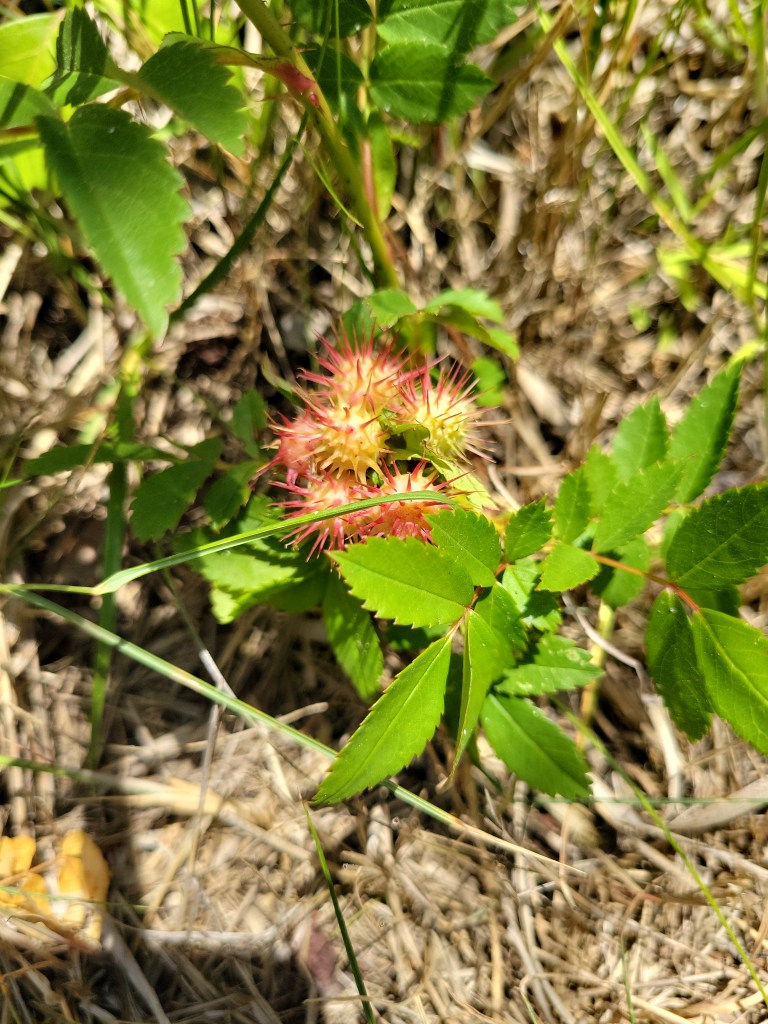
Although ISBP recognizes the edge of the road as its own zone, I did not make many observations as we crossed (being mindful of cars). Across the road, however, I was taken with the diversity of the maritime forest. Here we saw pitch pine (Pinus rigida) and a variety of oaks including Southern red oak (Quercus falcata) and willow oak (Quercus phellos), consistent with the pine-oak forest we observed on the mainland when we crossed into the Outer Coastal Plain. We saw that the serviceberry or Juneberry trees (Amelanchier canadensis) were in fruit, although most affected by cedar apple rust. I also observed many notable adaptations to the sandy and acidic but increasingly moist forest environment. For example, carnivory: spatulate-leaved sundew (Drosera intermedia) was almost hidden by the grass along the trail, but looking closely, we could see the glistening drops of mucilage that help this plant trap and absorb nutrients from small prey. Mutualism was represented by the rosettes of greenshield lichen (Flavoparmelia caperata) growing on a faded trail plaque; they are composite organisms formed of cyanobacteria and fungi filaments. We also observed rosy, spiky spheres that looked like spiny fruits growing on various rose species; these were parasitic galls, housing the larval forms of spiny leaf gall wasp (Diplolepis polita).


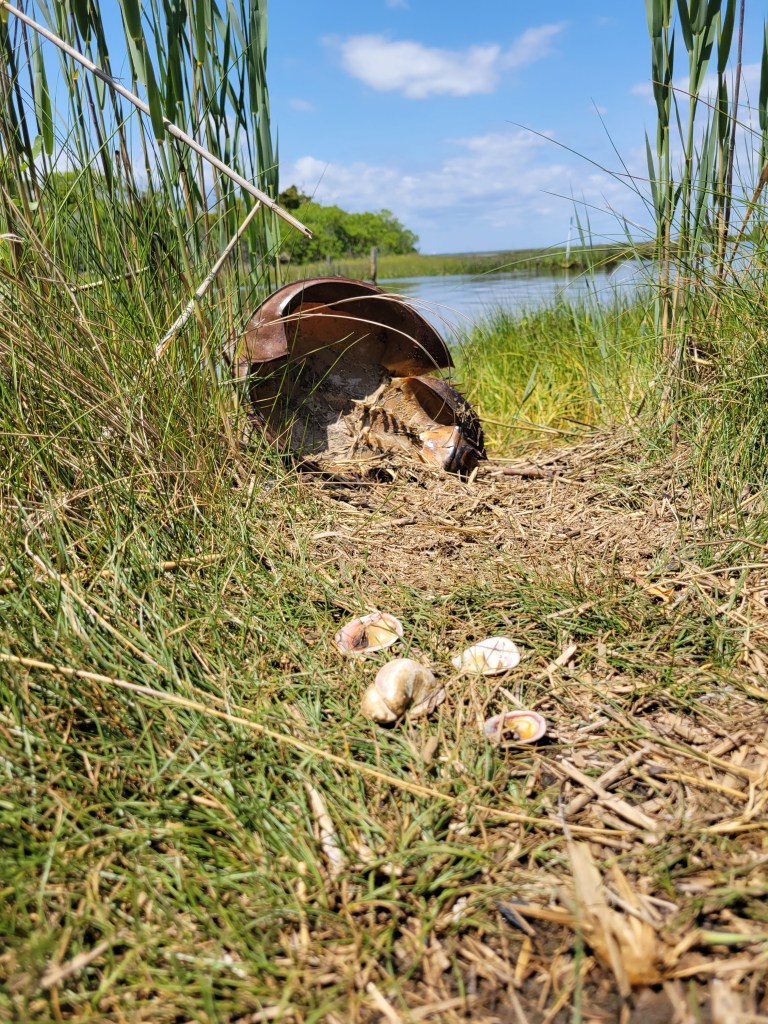
Beyond the maritime forest are tidal marshes, where the trail passes among saltwater channels lined with smooth cordgrass (Spartina alterniflora). I saw the empty carapace of a horseshoe crab (Limulus polyphemus) and a scattering of seashells (possible common slippers, Crepidula fornicata?) arrayed in a puzzling tableau; we also saw many redwing blackbirds (Agelaius phoeniceus) and a few snowy egrets (Egretta thula).
On the bayshore, the introduced species common reed (Phragmites australis) found a foothold (or rhizome-hold) on the edge of Barnegat Bay despite the salinity. Hedge bindweed (Calystegia sepium), which resembles morning glory vines, grows low over the sand, perhaps serving a similar purpose to the erosion-reducing rhizomes of beach grass on the drier primary dune. Tangles of eelgrass (Zostera marina) washed ashore from the submerged marine environment.

Cattus Island County Park
Connected to the mainland, Cattus Island County Park is dominated by two plant zones: a maritime upland forest, dominated by pitch pine and oak such as the blackjack oak (Quercus marilandica), and a freshwater swamp. This forest shades the parking lots and recreational areas we passed. The freshwater swamp was once dominated by sourgum or blackgum trees (Nyssa sylvatica) and Atlantic white cedar (Chamaecyparis thyoides), but saltwater intrusion in this area (due in part to Hurricane Sandy, possibly also to sea level rise) caused many of the trees to die. Many of their trunks remain–especially the Atlantic white cedar, which is rot-resistant–and form a striking ghost forest (and a home for the ospreys that nest in this area).

The swamp features many different varieties of grasses, including smooth cordgrass, the ubiquitous common reed, and salt grass (Distichlis spicata). At areas of higher elevation, such as the elevated footpath through the marsh, we observed groundsel-bush (Baccharis halimifolia) and marsh elder (Iva frutescens). Standing at a certain point on the path, I could almost perceive the different types of vegetation as stripes or zones–not unlike the plant zones of IBSP, but on a small scale.

Conclusion
This trip gave me so much new information to digest. One of my biggest takeaways is how much topography influences not only what vegetation grows, but how it grows: as a case in point, the black cherry trees that appeared in both the secondary dune and thicket were morphologically very different than the cherry trees I’ve planted in 3×3 pits of artificial fill along city sidewalks. I was also very interested to see how different species might coexist peacefully–such as the flowering understory that offered food and habitat to small animals in the shade of the tall pines and oaks–while other species seemed to compete for an edge in this unusual ecosystem (such as the carnivorous sundew in the maritime forest, or the native beach grass versus the introduced sand sedge on the primary dunes). Finally, as a watershed steward who often works with plants in poorly drained soils–both naturally saturated areas such as riverbanks and artificially saturated areas such as the landfill lakes of FDR Park–I am interested to see which species thrive in wet soils (like the aggressive common reed) and which are harmed by encroaching water and/or salinity (such as the cedars and sourgums). I hope that further exploration of other ecosystems gives me additional context and insight for these phenomena.
 Sara Davis
[…] to the towering maritime forest and through to the salt marsh and bayshore on the other side. I wrote about it–and will post my field reports for others as I get through them.My shoulders were sore for […]