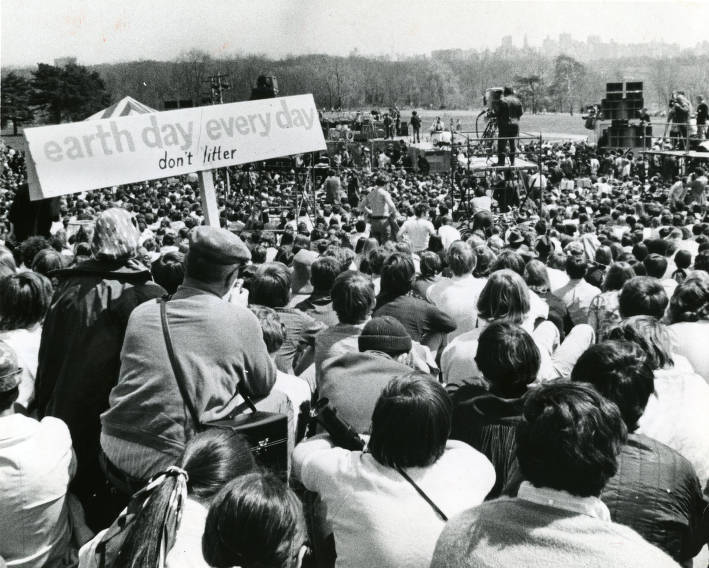
On April 22, 1970, thousands of Philadelphians gathered on Belmont Plateau in Fairmount Park to celebrate the first ever Earth Day. It was a star-studded event. Redbone performed. Ralph Nader spoke. Allen Ginsberg read “Howl.” Frank Herbert, author of Dune, gave a speech. The crowd in Philadelphia joined 20 million Americans across the country who wanted to do something about the environment. They’d seen oil spills, they’d seen rivers burning, they’d gotten sick from smog, and they wanted to see change. (Sources: Wikipedia, Schuylkill Center, WHYY.)
And they did. That first splashy Earth Day event was the visual and experiential manifestation of a collective movement toward change. 35 years later, when I first moved to Philadelphia, I didn’t dream of the Schuylkill River catching on fire. My neighbors didn’t worry that the air will kill their children. I didn’t even know such disasters were possible. That blissful ignorance and relative sense of safety came from regulations and policies that were made possible in part by demonstrations like Earth Day.
2026, so far, has been darkened by the unbelievable and the unspeakable. Just this month, we spent a day wondering if the U.S. president would unleash nuclear war. We have seen the ongoing horrors of a starving Gaza nearly drowned out by the horrors of repeated military strikes in Lebanon, despite an alleged ceasefire in the Middle East. Stateside, we continue to see everyday safety and security eroded while we watch tech companies play chicken with the inevitable bursting of their self-inflated AI bubble.
But we have also seen local and legal resistance, as communities all over the state have been voicing their refusal to accept polluting data centers in their communities. April is the month in which many of us celebrate our connection to the natural world via Earth Day cleanups, educational programs, and stewardship. And it is spring in North America, and the streets of Philadelphia are lined with fluffy pink trees and drifting showers of petals. It’s good to remember that as humans we possess the capacity for beauty, wonder, goodness, and benign weirdness as much as anything else. This month’s roundup starts out bleak, but you’ll find heartening news at the end. Let’s celebrate the wins and honor what we value.
What the White House is up to
This is a pretty typical experience since 2025… I prepared to post my last climate roundup at the end of February, skimmed my various news feeds to see if I was missing any major developments, hit publish… and woke up the next morning to another front in the U.S. government’s endless, senseless wars.
War is always an environmental issue. The 2026 Iran War perhaps more pointedly than most.
The Iran War Is Also a Climate War (The Nation, March 5, 2026)
Related, an older article: Why War Is One Of The World’s Biggest Climate Threats (Forbes, March 26, 2025)
Why? Well, there’s the oil.
Petromasculinity Is Eating Itself and Destroying Us All (Drilled, March 23, 2026)
Oil and gas crisis from Iran war worse than 1973, 1979 and 2022 together, says IEA (The Guardian, April 7, 2026)
And the water.
Oil built the Persian Gulf. Desalinated water keeps it alive. War could threaten both (AP News, March 8, 2026)
And the fallout.
Dark, like our future’: Iranians describe scenes of catastrophe after Tehran’s oil depots bombed (The Guardian, March 8, 2026)
The toxic fallout of US-Israeli attacks will be felt for generations (Canary Media, March 17, 2026)
Even with all that going on overseas, the US government still found ways to kneecap environmental health in the States.
US exempts Gulf of Mexico drillers from endangered species rules (Reuters, March 31, 2026)
U.S. Forest Service unveils extensive closures of research facilities (Science, April 3, 2026)
“Economic Civil War”: States Push Laws to Shield Oil and Gas Companies From Accountability (Propublica, April 7, 2027)
US agency proposes rolling back rules for safe disposal of toxic coal ash (Guardian, April 9, 2027)
Climate impacts
Sea level much higher than assumed in most coastal hazard assessments (Nature, March 4, 2026)
Earth’s spin is slowing at an unprecedented rate, thanks to climate change (Scientific American, March 13, 2026)
Record-breaking March heatwave, intensified by climate change, continues to shatter records across the U.S. (Climate Central, March 24, 2026)
Water conservation works, but climate change is outpacing it: Phoenix, Denver and Las Vegas offer a glimpse of the future (The Conversation, April 8, 2026)
The U.S. smashed heat records in March. Just wait for El Niño this summer (PBS News, April 9, 2026)
Research
Best headline: Google pledges roughly three hours of its annual profit to fight climate change (Engadget, March 5, 2026)
To keep climate science alive, researchers are speaking in code (Grist, March 27, 2026)
AI and the environment
Does Generative AI “Work”? That’s a Misleading Question. (The New Republic, March 16, 2026)
Big AI Is Gambling with the Planet’s Chips (Drilled, March 23, 2026)
Bombs and Porn Are Bad Reasons to Build More Data Centers (The New Republic, April 14, 2026)
Why Big Tech companies got quiet on climate change (Fast Company, April 14, 2026)
Resistance to data centers continues on a local level:
Google data center water estimates go public, residents in Roanoke and Botetourt react (WSLS, February 25, 2026)
Six data center campuses are planned for just one Pa. borough. Residents are fighting back. (March 19, 2026)
Wisconsin city passes nation’s first anti-data center referendum (Politico, April 8, 2026)
The annoying buzz of our AI future is keeping Vineland awake (Philadelphia Inquirer, April 2, 2026)
Missouri town fires half its city council over data center deal (Politico, April 13, 2026)
Elon Musk’s xAI Sued by NAACP Over Memphis Data Center (Wall Street Journal, April 14, 2026)
And here’s a new mapping tool: Data Center Proposal Tracker
Climate movements
A loose category for some thinkers calling for what this moment needs to keep momentum.
Yes we can no we didn’t (Technosphere Earth, March 5, 2026)
Long read, but a good one:
All for One: The urgent need for solidarity between the climate and labor movements (Orion, April 1, 2026)
Climate, State, and Utopia (Boston Review, Spring 2024 issue)
Not sure how I feel about this, but it’s definitely intriguing:
‘I’m worried there’s too much of me,’ says a birch: inside the interspecies council giving nature a voice (The Guardian, April 10, 2026)
How do you parent in ecodistress? (Culture Study, April 15, 2026)
Some good things
London, San Francisco and Beijing achieve ‘remarkable reductions’ in air pollution (The Guardian, March 12, 2026)
Monarch butterfly population increases by 64% (World Wildlife Federation, March 17, 2026)
A connection to nature fuels well‑being worldwide, according to a study of 38,000 people (The Conversation, March 25, 2026)
Just gorgeous: Frank Relle’s Photos Revel in Louisiana’s Otherworldly Swampland (Colossal, March 26, 2026)
We Mapped Out Where the Best Spring Blooms Are In NYC (The City, April 8, 2026)
I don’t know that this is a good thing per se, but it is an interesting thing, and I cannot resist heist stories that center on unusual stolen goods. Like… cacti.
My road trip with the do-gooding cactus smugglers (The Economist, March 6, 2026)
How ‘eco‑dystopian’ novels from Asia and Africa are pushing boundaries (The Conversation, April 2, 2026)
Points of Intersection: Science and Poetry is an anthology of poems written by scientists. From the organizer:
“These poems emerged from the third cohort of Science Communication Through Poetry, an online course I ran through Edinburgh Napier University in Autumn 2025. Seventy-nine participants from across the world joined us: biologists and physicists, nurses and engineers, poets and professors, students and seasoned practitioners. All united by a shared conviction that science and poetry belong together.”

