
On Sunday, June 11, my ecology class went to the Pine Barrens. Although Philadelphia and New Jersey had been experiencing high values of particulate matter due to the wildfires in Quebec, the air seemed to have improved by the weekend, and it was a sunny and clear day. Although the forecast predicted temperatures in the high 80s, we were relatively shaded and cool on the forested river.
Due to the unusually dry conditions this season, the water level of the Batsto River seemed low. Nonetheless, there was enough of a current to carry us along until we reached the lake–and at times, to cause our kayaks to bump into fallen branches or each other. In “The Ecological Pine Barrens of New Jersey” by H.P. Boyd, I read that all of the water within the Pine Barrens originates from within the Pine Barrens; there are no streams that originate outside of the Pinelands and flow into it. All of the rivers in this region form from the flow of groundwater discharge from the Cohansey aquifer as well as precipitation. This caught my attention because, as a watershed steward in Philadelphia, most of the waterways I encounter are far from their origins and downstream of so many other communities. I was particularly interested in the ways this unique water source and its protected forest region influence the ecosystem.
The “cedar waters” of the Pine Barrens
The Batsto River appeared reddish-brown in the sunlight, which the Pinelands Preservation Alliance (PPA) calls “tea-colored” and H. P. Boyd calls “cedar waters.” According to Boyd: “This coloration, often more observable in summer than in winter, derives from a chemical complex caused by a combination of their absorption of decomposed vegetative dyes such as tannin and by their high soluble iron content.”

The guide who drove us to the start of our six-mile journey mentioned that the Pinelands water was considered incredibly pure, almost glacially so, which could possibly be attributed to several factors such as the sandy deposits that characterize the Outer Coastal Plain and the measures taken to preserve the Pinelands from being developed or exploited for resources (other than recreation). But New Jersey, like Pennsylvania, has hundreds of impaired waterways, so I became curious whether the rivers in the region were considered impaired by the Environmental Protection Agency despite the relative protection from agricultural and industrial waste as well as aesthetic practices such as channeling and clear-cutting. The answer is yes: the Batsto and the river it flows into, the Mullica, are considered of low to moderate concern–mainly due to pH, but partly due to levels of lead and other pollutants. The PPA’s “Save the Source” campaign notes that the water table is quite shallow, which makes it vulnerable to pollutants that seep through the surface.
Nevertheless, the Batsto River is the healthiest waterway I’ve seen up close (except perhaps the rehabilitated stream at the Stroud Water Research Center). The current was slow. The banks varied in steepness due to natural erosion and deposition processes. Shade from trees right up along the bank help regulate the water temperature, and although the fallen branches and trees posed challenges for kayak navigation, they increase habitat diversity for water-dwelling species by providing nooks and surfaces for plants and macroinvertebrates to dwell.
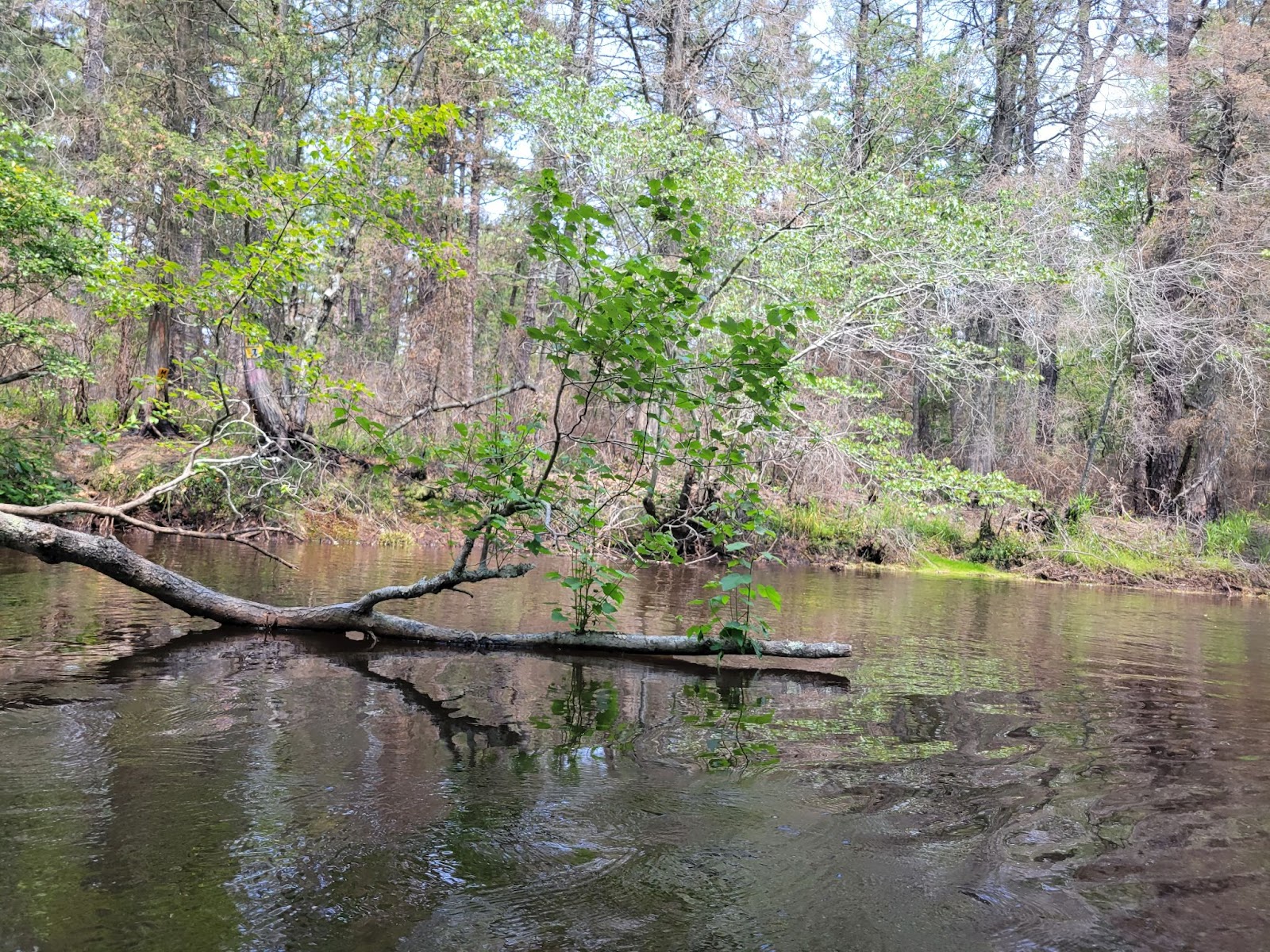
Along the banks of the Batsto
The first few miles of our river route were characterized by pine-oak forests along the banks. Tree species we could see from the river include sour gum (Nyssa sylvatica), pitch pine (Pinus rigida), and trident red maple (Acer rubrum var. trilobum). Where a shrub layer was present, we noticed viburnum species such as arrowwood (Viburnum dentatum), which was in bloom, inkberry (Ilex glabra), and sweet pepperbush (Clethra alnifolia). In some places which had been impacted by fire, the scaly-barked pitch pines remained, but the shrub layer was emergent or depleted.

Some herbaceous plants on the banks were in flower, including Northern blue flag iris (Iris versicolor) and the lance-leaved violet (Viola lanceolata). We also noticed rushes, including common beak-rush (Rhynchospora capitellata) and bayonet rush (Juncus militaris), as well as bur-reed species (Sparganium sp.) and bog button (Sclerolepis uniflora) both in and out of the water. Some riparian species such as pickerelweed (Pontederia cordata) and arrow-arum (Peltandra virginica) have arrow-shaped leaves–an aerodynamic shape, to prevent damage from wind.

Birdcalls recorded by Merlin included the Great Crested Flycatcher (Myiarchus crinitus), Red-eyed Vireo (Vireo olivaceus), American Redstart (Setophaga ruticilla), Blue-gray gnatcatcher (Polioptila caerulea), Common Yellowthroat (Geothlypis trichas); of these, I only saw the common yellowthroat in flight–a dramatic flash of yellow in the trees.
It was, however, a fantastic day for turtle-spotting–including spotted turtles (Clemmys guttata), which came as a surprise to the Pinelands guide. We also saw Eastern painted turtles (Chrysemys picta), red-bellied turtles (Chrysemys rubriventris), and Eastern box turtles (Terrapene carolina).

The Atlantic white cedar swamp
Further downstream, we passed some lowlands and savanna areas dominated by Atlantic white cedars (Chamaecyparis thyoides) with bluish bark. The number of fallen trees seemed to increase, to my eyes–my phone battery failed, so I could not photograph the section of river where towering cedars tilted over the water from both banks, forming almost a series of arches along the river. The Atlantic white cedars are shallow-rooted, so they are more likely to fall over when dead or damaged. They also don’t recover from fire, unlike the pitch pines upstream.
The grassy areas near the Atlantic white cedar swamp are sometimes submerged–they were just a little muddy during our visit–and they boast an astonishing variety of plantlife. There were fruiting shrubs like inkberry (Ilex glabra) and large cranberry (Vaccinium macrocarpon). There were striking wildflowers among the grasses, including rose pogonia (Pogonia ophioglossoides) and grass pink (Calopogon tuberosus), as well as many patches of round white pipewort flowers (Eriocaulon sp.) At one stop, we walked through a spongy patch of peat moss species (Sphagnum spp.), reminding me why this absorbent plant has historically been used for everything from mattress stuffing to wound dressing.
And, given the acidic water and sandy soil, I should not have been surprised to see so many carnivorous plant species–but I was. Pitcher plants (Sarracenia purpurea) are larger and more succulent in appearance than I expected; we saw flowers as well as the leaves forming “pitchers” to catch water and insects. (We didn’t see any insects in the water except a species of mosquito that has adapted to live there in its larval state). Bright yellow bladderworts (Utricularia subulata) grew on the sandy banks. The trail in one section was practically carpeted in sundew, both spatulate-leaved (Drosera intermedia) and thread-leaved (Drosera filiformis).

Batsto Lake
There are no natural lakes in the Pine Barrens, but some lakes were created by impoundments or dams to power industries such as the Iron Furnace that once turned bog iron to pig iron along Lake Batsto. Today the lake is relatively still–we paddled without the benefit of a current for the final mile–and populated with floating species including white waterlily (Nymphaea odorata), spatterdock (Nuphar lutea ssp. variegata), lilypad-like watershield (Brasenia schreberi), and more carnivorous bladderwort (Utricularia inflata). There were also submerged species including bayonet rush (Juncus militaris) and the trunks of dead Atlantic white cedar. In the pine-oak forest along the banks of the lake, we could see a profusion of mountain laurel (Kalmia latifolia) in bloom, as well as scattered turkeybeard (Xerophyllum asphodeloides).
In these still waters, I saw several groups of an unknown species of duck, possibly mallard (Anas platyrhynchos): two were feeding near the river, while in the lake a fluffy duckling was following its mother away from our kayaks. One of a pair of Canada geese (Branta canadensis) actually approached our kayaks, causing us to paddle away through a tangle of spatterdock and rushes; we seemed to have gotten too close to its nesting mate, and the goose came at us hissing with its neck arched and wings outstretched.
Conclusion
During this trip, I realized that despite my volunteer work and training in watershed health, and despite my understanding that biodiversity is desirable for ecosystems including city sidewalks as well as wetlands, I haven’t given much thought to water diversity. I assumed that water needs to have a neutral pH to be healthy and support plant and animal life. The “cedar waters” of the Pinelands may be more acidic than we consider normal for water rising from an aquifer, but they support a lush and diverse ecosystem of species that have adapted to this environment.
Sources
“The Ecological Pine Barrens of New Jersey” by H.P. Boyd. Plexus Publishing, 2008.
“New Jersey Impaired Waters List.” United States Environmental Protection Agency. Accessed June 17, 2023. https://www.epa.gov/tmdl/new-jersey-impaired-waters-list
Pinelands Preservation Alliance. Accessed June 17, 2023. https://pinelandsalliance.org/
Save the Source. Accessed June 17, 2023. https://www.savethesource.org/about-the-aquifer/
 Sara Davis
[…] Narrowleaf mountain mint. Deptford pink, much smaller in size than we previously observed in the Pine Barrens. […]
[…] of the month, I corralled a group of 11 adults for a day of kayaking down the Batsto River–same route that I took last year. It was objectively a gorgeous day, warm and bright but not too hot in the shade, and the water was […]