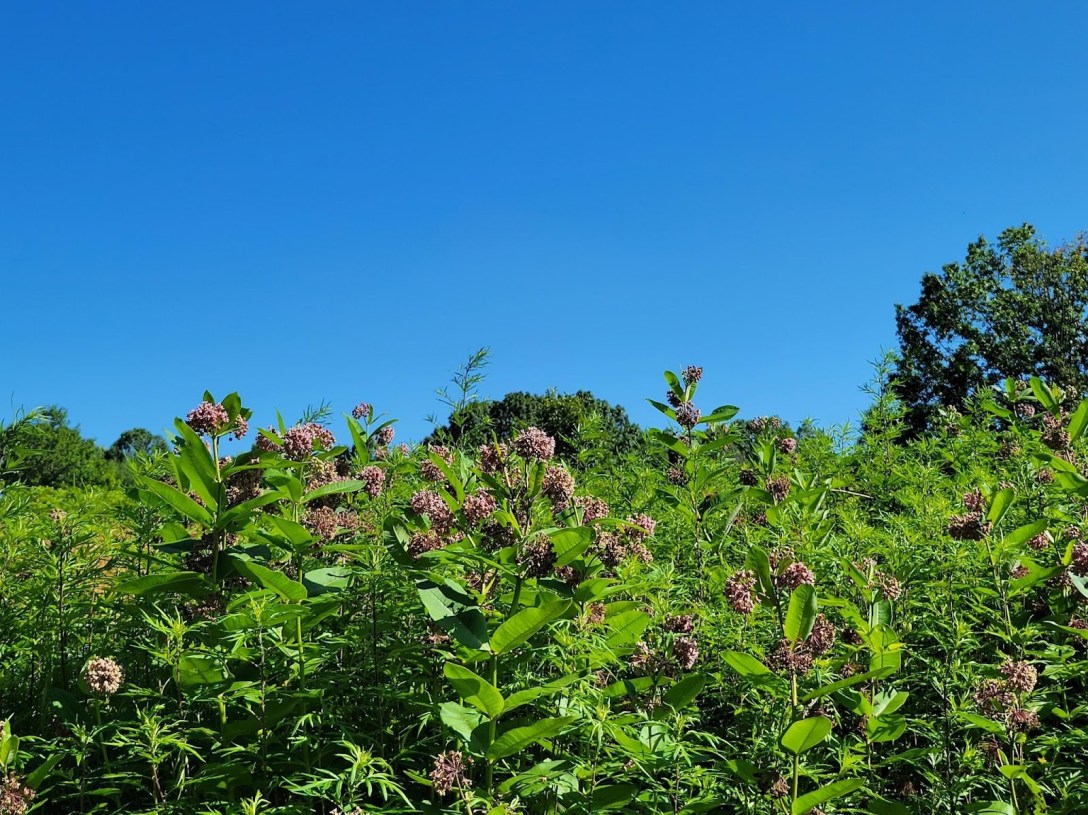
On Sunday, June 25, my ecology class visited the Wissahickon Valley Park, situated in northwest Philadelphia along the Wissahickon Creek. The park is located in the Upland Piedmont region of the Piedmont province; the creek runs through a gorge characterized by schist and gneiss, crystal-flecked metamorphic rocks used for building materials in many historic structures in the region (including Eastern State Penitentiary). The morning of our visit was sunny, warm, and humid, with rain and thunderstorms forecasted for the afternoon.
As we explored Houston Meadow and the adjacent forest, I kept thinking about ecological opportunity. Houston Meadow is a stewarded meadow, reclaimed by removing unwanted trees and shrubs and maintained by a combination of mowing and herbicides. The meadow features a number of native plants that provide food and habitat to pollinators and bird species, but inevitably a number of introduced plant species find their way to the meadow from nearby residences and commercial lots. In my volunteer training, we refer to introduced species as “opportunistic” species, particularly if they have a tendency to flourish and outcompete native species in disturbed or depleted urban environments. In the forested area, the most noticeable disturbance was the presence of large dead or fallen trees. The death of a mature tree is a serious loss in an urban forest. Philadelphia has released a strategic plan to increase its canopy in ten years; ten years is also, perhaps coincidentally, the average lifespan of a city tree in Philadelphia. It was troubling to see the decay of enormous trees, representing years of growth, but at the same time, a fallen tree offers opportunity to its neighbors in a forest.
Houston Meadow

Houston Meadow is designed to have variation in vegetation structure and composition to provide different habitats and feeding sites for the bird species park stewards hoped to attract. The trail we followed winds through a field of grasses and flowers, both native and introduced. There were some I recognized from Rancocas State Park: orchard grass (Dactylis glomerata), timothy grass (Phleum pratense), hemp dogbane or Indian hemp (Apocynum cannabinum), yarrow (Achillea millefolium), and common milkweed (Asclepia syriaca)—which was bursting with sweet-smelling purple blossoms, attracting milkweed beetles (Tetraopes tetrophthalmus) as well as winged insects. I was excited to see some species I know from my own garden, such as beardtongue (Penstemon digitalis), or from my kitchen, such as great or common mullein (Verbascum thapsus). Chinese silver grass (Miscanthus sinensis) is an introduced species that is new to me; common mugwort (Artemisia vulgaris) is an introduced species I know well from park stewardship. Closer to the ground we saw bracted plantain (Plantago aristata), slender yellow woodsorrel (Oxalis dillenii), tiny florets of black medick (Medicago lupulina), and the introduced species bittersweet vine (Celastrus orbiculatus).
There were also shrubs and saplings emerging from the herbaceous grasses and forbs–most notably several species of bramble, possibly including Allegheny blackberry (Rubus allegheniensis) and black raspberry (Rubus occidentalis). I was surprised to see a shrub species of honeysuckle: Morrow’s honeysuckle (Lonicera morrowii), with bright red berries, is introduced and can be as opportunistic as its viney cousins (such as Japanese honeysuckle, Lonicera japonica, was also present in the meadow). The native shrub deerberry (Vaccinium stamineum), which resembled a blueberry bush with larger and paler berries, was laden with unripe fruit.

Here and there a taller tree rose up from the meadow, including staghorn sumac (Rhus typhina) (Photo 3), Eastern red cedar (Juniperus virginiana), Eastern white pine (Pine strobus), American holly (Ilex opaca), and oak species including pin oak (Quercus palustris) and the shingle oak (Quercus imbricaria) with clusters of long, shiny leaves. The Pacific crabapple (Malus fusca) is not native to this meadow.

Although I didn’t get a visual identification on any birds except a few loud gray catbirds (Dumetella carolinensis), who were not shy about flying in and out of the shrubs we examined, the Merlin app picked up several more bird calls: American goldfinch (Spinus tristis), house wren (Troglodytes aedon), field sparrow (Spizella pusilla), song sparrow (Melospiza melodia), and red-eyed vireo (Vireo olivaceus). There was also a stunning orb web stretched among the grasses and taller flowers.

The forested slopes

The woods adjacent to the forest and along the trails leading to the creek featured many mature trees reaching a great height, predominantly oak species including white oak (Quercus alba) and chestnut oak (Quercus montana), but also including black birches (Betula lenta) and tulip trees (Liriodendron tulipifera), the latter of which I had previously only seen in sapling form. Among the shorter subcanopy trees were red maples (Acer rubrum), umbrella magnolia (Magnolia tripetala), introduced Japanese angelica tree (Aralia elata), and a surprising (to me) number of the introduced Amur corktree (Phellodendron amurense), particularly along the trails with a steeper slope. Although we saw hickory species in both the forest and meadow, some small trees grew low enough on the slopes that I could see the sulfur yellow bud identifying it as a bitternut hickory (Carya cordiformis).

We saw more deerberry in the forest—inside and outside of the deer exclosure—as well as the aromatic spicebush (Lindera benzoin), witch hazel (Hamamelis virginiana), maple-leaved viburnum (Viburnum acerifolium), and the introduced and opportunistic burning bush (Euonymus alatus). A number of different fern species appeared throughout the forest, varying with the topography: common bracken (Pteridium aquilinum) and New York fern (Thelypteris noveboracensis) seemed to prefer the drier elevated areas, while Christmas fern (Polystichum acrostichoides) and hay-scented fern (Dennstaedtia punctilobula) grew on the slopes. We found horsebalm (Collinsonia canadensis), an aromatic plant with the squared stem of the mint family, close enough to spicebush that I wondered if they had been planted intentionally along the trail to discourage insects. We also saw whorled loosestrife (Lysimachia quadrifolia), a native plant with striking leaves in the elevated forest, sweet Joe-Pye-weed (Eutrochium purpureum) along the slopes, and a fair amount of introduced and opportunistic multiflora rose (Rosa multiflora) throughout.
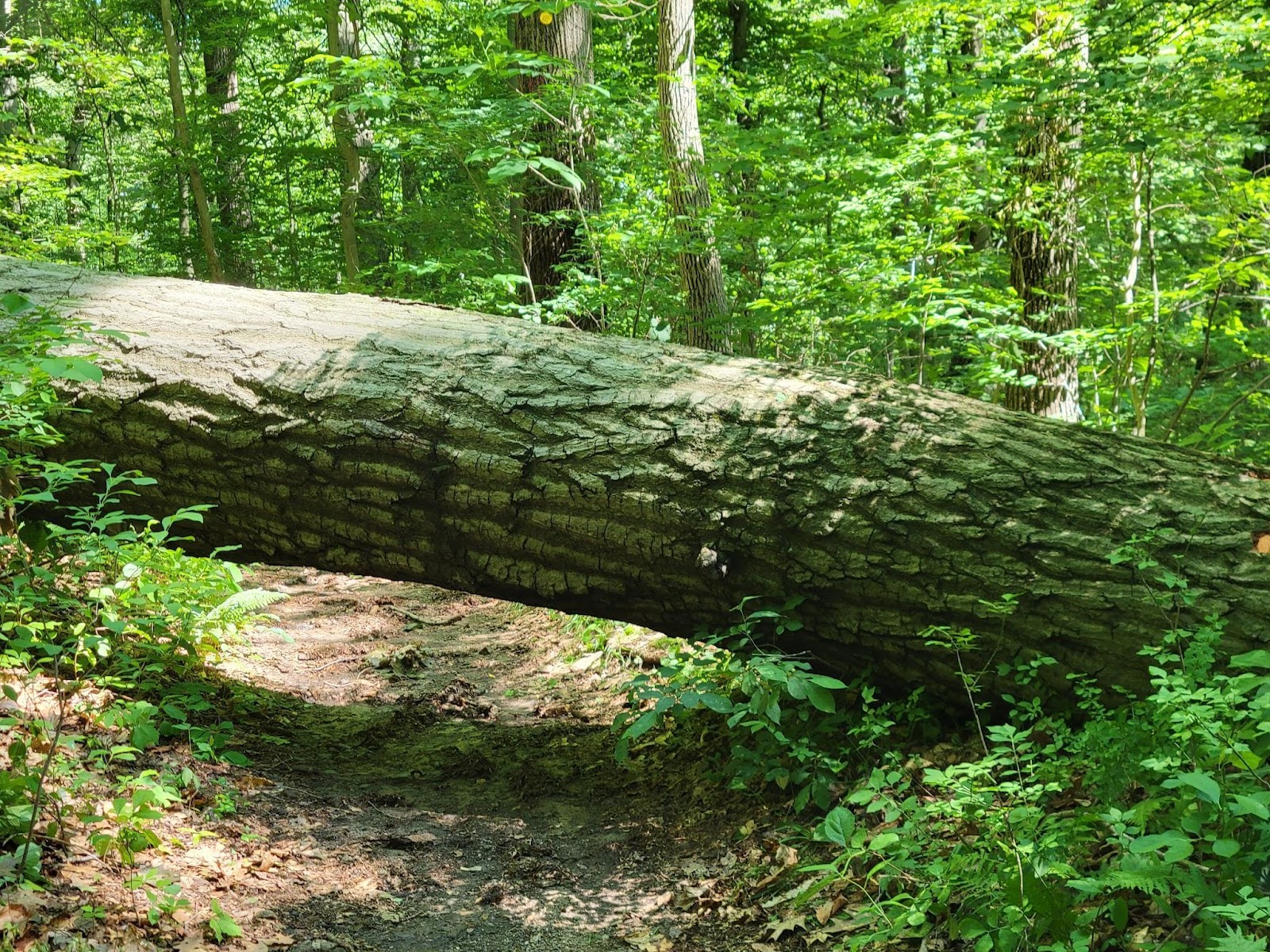
On the way to the north meadow, we heard a loud crack. Further up the trail, a large tree (possibly red oak, Quercus rubra) had fallen across the path—relatively recently. The air smelled like freshly sawn planks. While this mature tree seemed to have come down recently, there were a number of other broken trunks along the trail in various stages of decay. Fallen trees offer opportunities for some understory species, such as bracket fungus (Cerrena sp.) that feeds on the rotting wood, or saplings that thrive in the gap in the canopy.

Although I could see little bird movement in the canopy, the Merlin app recorded a variety of birdsong: tufted titmouse (Baeolophus bicolor), wood thrush (Hylocichla mustelina), Northern cardinal (Cardinalis cardinalis), ovenbird (Seiurus aurocapilla), red-bellied woodpecker (Melanerpes carolinus), and Eastern Wood-pewee (Contopus virens).
Conclusion
As a park volunteer, I have spent many afternoons snipping the top six inches off of mugwort stalks to prevent seeding (and to make tea), or pulling multiflora rose vines out of mature trees, some of which had literally twisted their substantial trunks into knots beneath the strangling vines. I have no doubt that well-tended Wissahickon Valley Park, with its large and active Friends volunteer group, spends some of its work sessions doing similar maintenance. Yet in the admittedly limited snapshot of one morning’s walk, I was struck by how both native species and the introduced species seemed to be thriving in the same space. With the exception of the fallen or decaying red oaks, I didn’t see evidence that native species were struggling to flourish in the vibrant meadow ecosystem or the cool, shaded forest.
Sometimes I’ve heard people describe invasive or opportunistic species as occupying an ecological niche that would otherwise be occupied by a native species—and that can be a concern because native plants tend to provide more ecological services such as deep erosion-fighting roots and food or habitat for native animal species. As a visitor, it’s hard to say whether the birds and beetles would be better accommodated if the more milkweed or dogbane replaced mugwort in the dense meadow patch, or if the Wissahickon Valley Park canopy contributed significantly less carbon dioxide and stormwater uptake after its red oak decline. Either would make for a fascinating study over time.
 Sara Davis
[…] We observed diverse shrubs, vines, and herbaceous plants reminiscent of the forest community in Wissahickon Valley Park: spicebush (Lindera benzoin), ferns such as interrupted fern (Osmunda claytoniana) and hay-scented […]
[…] Philadelphia got a true fall this year, with some gloriously bright foliage and a good number of crisp sunny days as well as cozy rainy ones. I enjoyed a good amount of time outdoors: in my favorite park, putting amaranth beds to sleep for the winter and collecting their bright magenta seeds; in my neighborhood, planting trees for neighbors; in my own yard, repotting and mulching and getting the tender plants inside. Thanksgiving is my least favorite holiday and I despise traveling for a weekend that is never long enough, but I did take advantage of the time off to enjoy an unhurried ramble in the Wissahickon, enjoying the autumnal colors of the plants I saw there in the summer. […]